I merged a pull request last week that turns Wordsworth, my web app for technical writers, into an agent skill. Install it with npx skills add phazonoverload/wordsworth and any agent with tool access gets seven writing analysis tools bundled in.
If your tool doesn’t connect to someone’s agent, it’s game over.
The app I stopped using
I built Wordsworth. I launched it. I haven’t opened it myself in months.
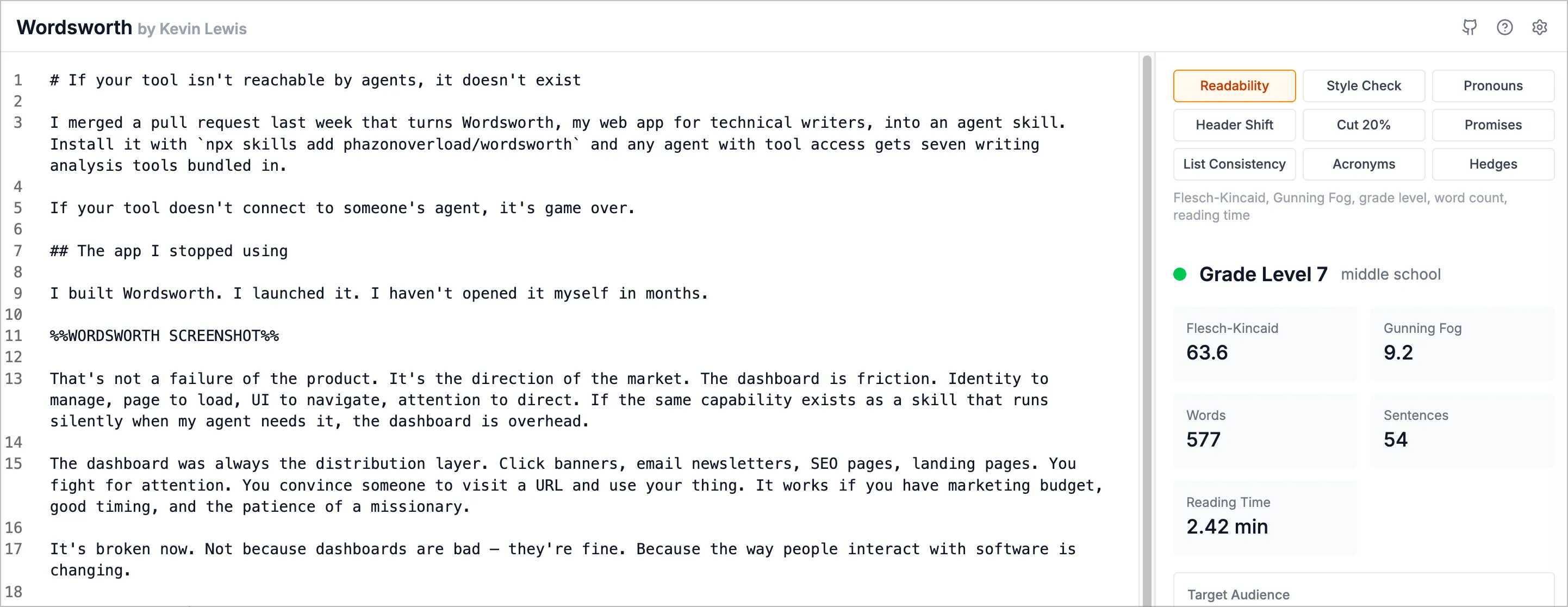
That’s not a failure of the product. It’s the direction of the market. The dashboard is friction: identity to manage, page to load, UI to navigate, attention to direct. If the same capability exists as a skill that runs silently when my agent needs it, the dashboard is overhead.
The dashboard was always the distribution layer. Click banners, email newsletters, SEO pages, landing pages. You fight for attention. You convince someone to visit a URL and use your thing. It works if you have marketing budget, good timing, and the patience of a missionary.
It’s broken now. Not because web apps and dashboards are bad—they’re fine. Because the way people interact with software is changing.
Agents are the new users
In a world where users have a single agent that integrates with various platforms, your job is to integrate with that agent. Skills and MCP servers are the way you do that.
The agent opens your tool, calls your capability, and the analysis happens. No human interface needed. The user describes what they want. The agent figures out the routing. Your tool just works.
At Apify, tens of thousands of AI tools are made available via our MCP server. Ready to discover. Ready to use. I see this every day: tools that exist, that work, that are useful, but nobody opens them because nobody knows they exist. Then someone makes them reachable as a skill, and suddenly they’re in the hands of thousands of users who never knew they needed them.
The distribution math flipped
Wordsworth has seven tools. Each does something different—readability scoring, hedge word detection, promise fulfillment checking. As a web app, you need to remember the URL, open the browser, paste text, click buttons, read results, copy them back. As a skill, my agent calls it and the analysis happens.
The skill format isn’t new. But the proliferation of agent platforms that consume skills changes the distribution math. A capability published as a skill can run on any agent that supports the format. Distribution with a standard onboarding and a standard way to invoke.

You could build the most sophisticated writing analysis platform on earth (mine was not, for what it’s worth). If your competitor ships as a skill that installs with one command and works inside whatever agent your team already uses, the competitor wins. Because it’s actually reachable.
The dashboard is a sunk cost
Wordsworth as a web app is a sunk cost. The future of this product is agents calling it. I’m okay with that.
Ten years ago, distributing software meant setting up a hosting infrastructure, building a landing page, running ads or doing SEO, writing blog posts, attending conferences, pitching journalists. All of that is overhead for a capability that people just want to use.
Now it’s a capability that lives wherever agents operate. A single markdown file. A tool definition. That’s the new distribution.
My web app isn’t a product anymore. It’s a skill. And that’s where Wordsworth belongs.